Campbell’s office was a tiny, wooden shed with one window, near the mouth of the river. Inside was a metal filing tray atop a wooden table and two chairs; Campbell was slouched into one of them, his legs on the table, arms folded behind his head. His eyes snapped open as we entered the room; he slid his legs back under the table and he upright, rearranging some stray papers on his desk. I wiped the sweat off my face with the corner of my t-shirt as Campbell flicked a switch and the ceiling fan began to stir. Gesturing towards the one spare chair he asked for both our passports and tapped our names onto the huge, black metal typewriter with sombre concentration.
Sleepy, sweltering Livingston lies at the bottom end of the Rio Dulce (‘Sweet River’) as it emerges into the Gulf of Honduras. A beguiling mix of Guatemalan, Mayan and Caribbean cultures and predominantly Garifuna, it gazes across the azure water towards Belize and its southernmost settlement of Punta Gorda, where we were heading. We had arrived by boat, too – as everyone and everything did – but crossing an invisible border between two countries in an open, private launch was a different undertaking, and one which Campbell took more seriously than his casual demeanour might indicate. He suggested we came back later: how about six o’clock? Meanwhile he would make the arrangements.
We returned to the shack at sunset. It was just along from where we were staying; few buildings fronted the red-mud road so we weren’t going to get lost, though the shed was unmarked and, as we had left our passports and a sum of money with an unknown man, we were a little surprised to find his ‘office’ locked up, with no-one in sight. Our boat transfer was planned for the morning, and darkness was falling. We did the only thing we could: sat down in the dust in front of the shed and waited. Soon enough a small, dark figure dressed in navy blue shuffled into view, holding up two passports and two carefully-typed documents which we should keep safe, he informed us. We should be at the jetty in good time; we must ask for our boatman, whose name was Carlos.
The year was 1995 and we were about to be smuggled, it appeared, out of Guatemala from a small, yet vibrant, backwater that I had never heard of, nor could have guessed at, before our arrival there; a dot which had not yet made it onto the mainstream travellers’ map and yet a place where, I would later come to realise, I left a piece of my heart.
* * *
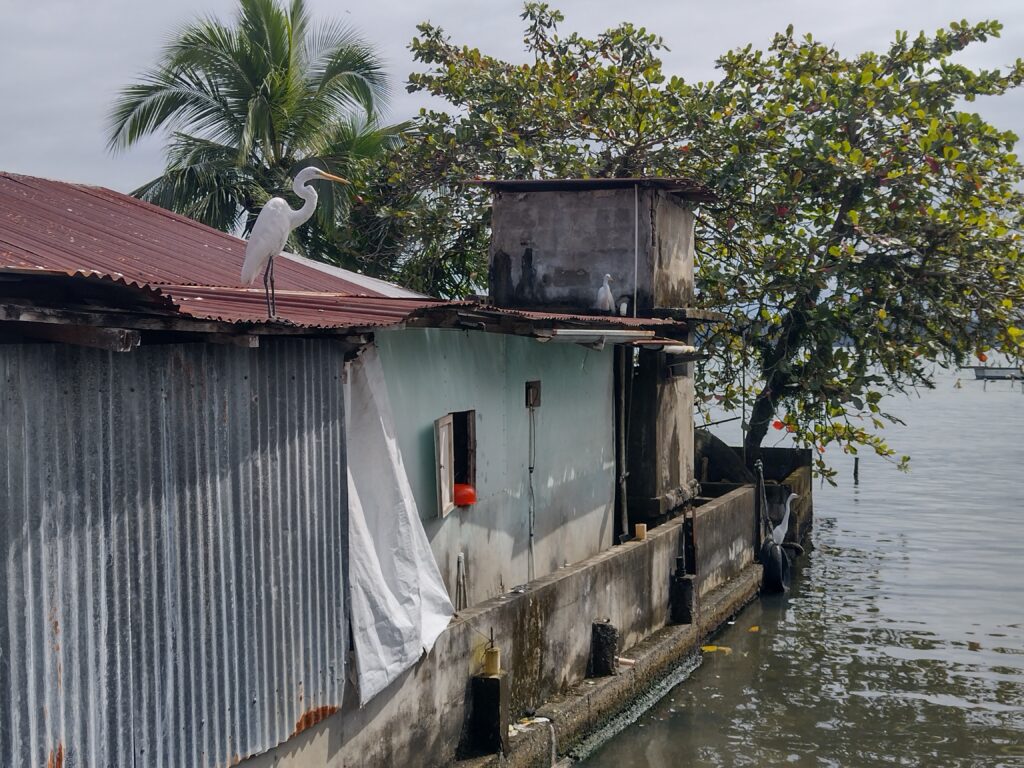
The water-taxi sped us down the Rio Dulce, splashing us with warm river-water as the rain-clouds cleared, and moored up directly in front of the Casa Rosada with its familiar pink archway, where we landed almost exactly thirty years ago. Brown pelicans still stood sentinel on the wooden jetty posts; the old building with its wraparound balconies and Belizean-style tin roof seemed little changed. Buildings had been added on over the years, as had rooms; during our previous stay we had taken two makeshift daybeds on the owner’s verandah as all the cabins were occupied. Long before internet and advance booking it was first come, first served, but we weren’t going to be turned away. The hospitality of the warm-hearted American owner was legendary, and the place was always filled with her revolving traveller-family.
Today I had a different companion with me and I was excited to show her the source of such tales. We were greeted on the jetty by Daniel, who was no more than a lustful thought when I last stepped through these doors. He took pride in showing me three framed photos on the wall of all the previous owners of the Casa Rosada: each one white, blonde, female and in their forties or fifties. It could have been any of them, though none struck a particular chord. I thought I remembered the lady owner’s name as beginning with a C. That must be Christy! Daniel surmised. It didn’t ring a bell, but it was a long time ago. None of them were there any more, not that I had dared hope to meet the same lady, whose lifestyle, choices and business skills had left such a huge and influential impression on me in unimaginable ways.
A little while later the current proprietor, Ismail, popped his head around the door.
‘I’ve heard you remember Cathy!’ he enthused.
Yes! That was it! Cathy. Of course. Ismail was overwhelmed that I had chosen to come all this way, after all these years, specifically to visit the Casa Rosada. I was a little overwhelmed myself as it had not been entirely planned, though that’s another story. Cathy, he told me, had recently been to visit, to celebrate her 80th birthday. She was the original owner, he said; the others were following in her footsteps. She’s well, he told me, and living in Mexico; he would write to her immediately and tell her this incredible news.
She didn’t remember me, of course, (perhaps she had waifs regularly camping on her balcony and I doubt she knew about the locking-myself-out-in-only-my-knickers incident), but she sent a hug. That was Cathy all over; she embraced all who came through her doors in an all-enveloping, virtual hug. We were her charges, her brood, and she showed me something I hold precious to this day: the magic of possibility. I could be a Cathy, too. If I had ever found, and taken, that kind of opportunity, I would have modelled myself on her.
It was not only the guest-house itself which I had been eager to revisit: the river itself has been lodged in my mind for all this time. Not least, I suppose, due to the mistake for which I don’t deserve forgiveness from my travel buddy, Sonia. I had been given the role of trip photographer as I had a ‘better quality camera’, using 35mm film, of course. Unfortunately the shutter of said camera jammed shut early on in the trip and none of the photographs I took on the river – the pictures I was most proud of and eager to see – came out. To say I was devastated is an understatement but I was also ashamed, as Sonia had noticed my shutter failing to open on one occasion and I had brushed her concerns aside.
These missing photographs would have recorded the most beautiful scenes of our trip, and have lived in my memory ethereal, fuzzy-focus, elusive as a mirage, for three decades.
Nowadays, boats leave the town of Rio Dulce, where the river of the same name broadens into Lago Izabal, and travel downriver to Livingston via some rainforest lodges along the banks. These rather lovely lodges were not there, nor was this a common journey, on my last visit and Cathy spoke of going upriver, ‘all the way to the lake,’ making it sound mystical, magical, almost unattainable and very Harrison Ford. I would have loved to have undertaken the journey, though we’d come the easy (longer) way, from Puerto Barrios. Looking at the map now, and having seen the number of boats plying the river, it’s hard to imagine why.
River trips, as far as the Biotopo Chocón Machacas reserve or to bays on the opposite side of the river still run, although rather than a gentle, slow meander through narrow channels they now usually include stops at some hot springs, Cueva del Tigre and so-called Texan Bay, which seems to be named after Mike from Texas who has a bar there. I just wanted to be back in my dream paradise where waterlilies carpeted the inlets and egrets hung gracefully from low-hanging branches.
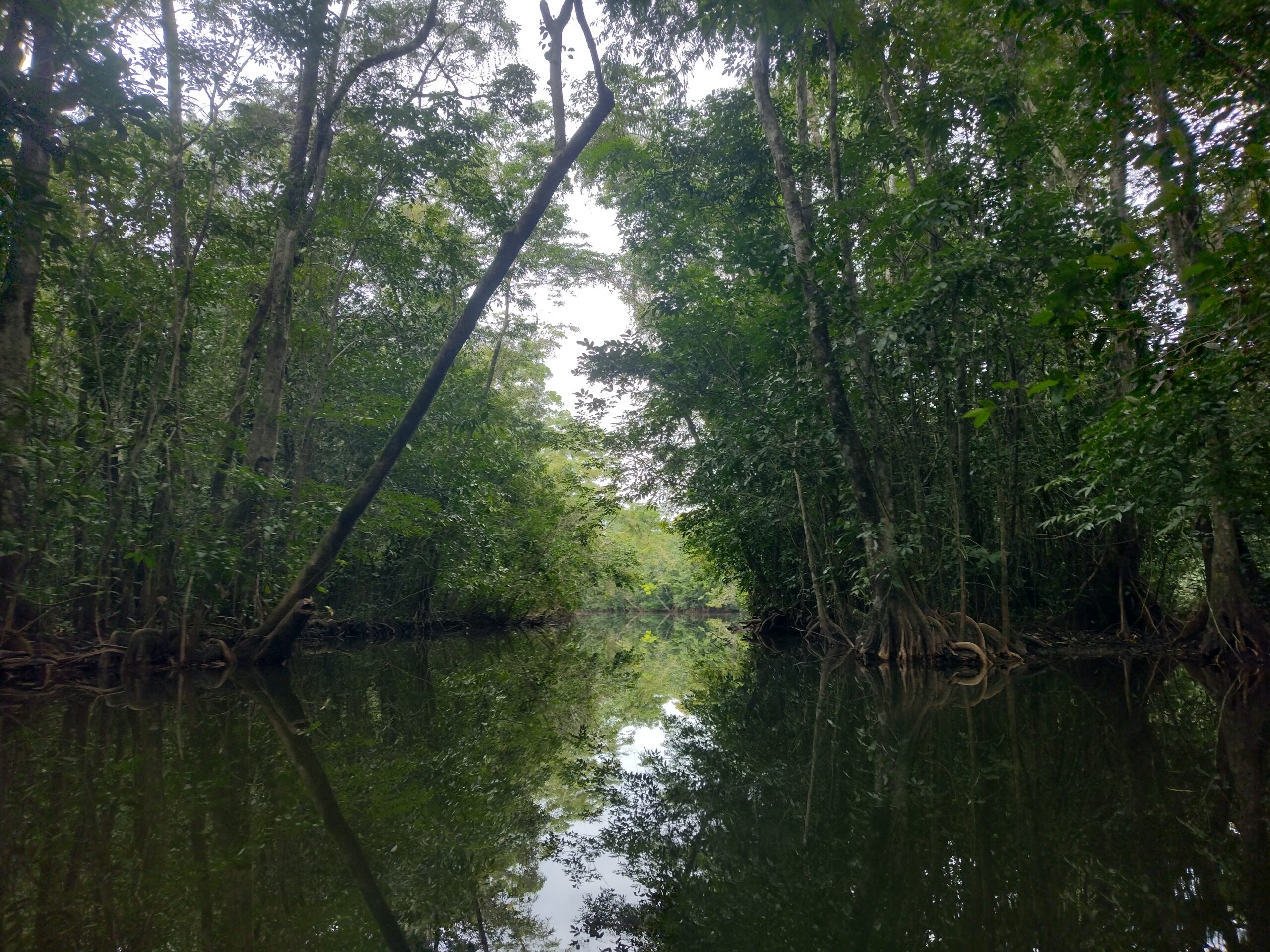
It’s still one of the most serenely gorgeous places on Earth. The red mangroves, which can grow eighty feet tall, line the channels, their twisted roots casting perfect reflections in the calm water. The waterlilies, though, are absent; according to Ismail, they were wiped out by a surge of salt water during one of the storms, something that happens periodically and from which they take time to recover.
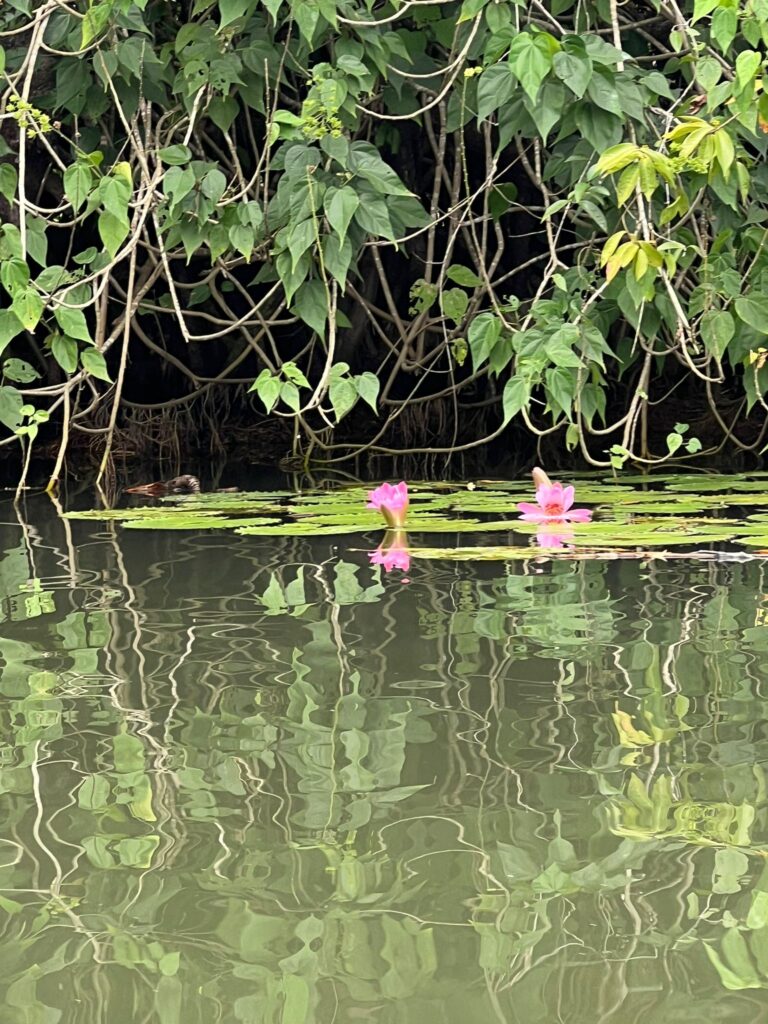
Some are thriving – and flowering – over the other side of the water, though, so I didn’t come away completely empty-handed, image-wise. This one, I confess, was taken by Caroline.
This part of the river is protected – it’s home to endangered Caribbean manatees as well as being a stronghold for the red mangroves – so has changed little in all these years, except for the number of visitors discovering its charms.
Hiring a kayak another day, becoming completely lost up tiny little waterways on a narrower part of the river and seeing not another soul until finding our target: a small waterfall with a clear, turquoise swimming hole, is the memory which will stay with me until I return again.
Last time, I doubted that I ever would. This time, I’m sure I will. Life’s strange like that.
Livingston itself has joined the modern world. Campbell’s shack has gone and the unpaved road it stood on is now tarmac. Trucks, tuk tuks and motorbikes with open exhausts whizz up and down streets where, in 1995, there were only feet; the town’s business was conducted by boat and there were only two vehicles in the whole vicinity. Now there are stalls selling tourist knick-knacks and a choice of low-key eating establishments. Not all development in the name of tourism is bad, however, although I admit it grudgingly: at least two cafés in modern-day Livingston offer non-dairy milks with the coffee. I would sacrifice this undoubted luxury in a heartbeat to bring back the waterlilies, naturally, though I am grateful.
To enter Belize by sea – the only way of doing so, once you’re in Livingston – still requires a trip to the emigration office. Now, it’s in the centre of town in a concrete building; it boasts at least two employees, and a sign above the door, though we still managed to walk straight past it. Passports are accepted through a hatch; no seat is offered. An exit tax is charged. The boat, while still uncovered, can carry at least ten passengers and it runs at a fixed time each day. We left in the morning and I realised that it was always going to be too soon. There’s not so much to do in Livingston, but one can always just be. Yet Belize was beckoning for another adventure, another long-overdue return and a separate story altogether.
To be continued!