‘I wish all the volunteers were like you,’ announced Mas.
I was rather taken aback. Weren’t they all like me? If not, what were they like?
It didn’t take me very long to realise that the majority of people volunteering at the cat sanctuary were budget travellers looking, primarily, for free accommodation from which to explore the beaches of Penang. The few hours a day they had committed to helping out was not at the top of their priority list, to the constant frustration of Mas and Amir, the skeleton permanent staff. Dedicated, compassionate, selfless but overworked, exhausted and frequently heartbroken yet refusing to be defeated, they were lucky to manage a few hours off during the week, let alone a full day.
I was there purely for the cats. The fact the sanctuary was set on a tropical beach was undoubtedly an attraction; photographs of healthy-looking cats strolling along the sands, tails stretching happily upwards, made it all look very romantic.
The reality hit me the first morning, as I nudged up the rickety stairs in the ramshackle wooden building to the neonate section, where Mas was bottle feeding and medicating the newborns. Freshly dumped at the sanctuary gates in sacks and boxes with, or without their mothers; just born, barely weaned or in some cases, still inside a bulging, ready-to-burst tummy, this was a regular occurrence. Some survived. Putting out a hand to steady myself, I almost sent a metal cage flying, complete with its tiny tabby occupant who screamed his displeasure, and from that moment on, yelled at me every time I walked past. I named him Batu (‘bay’), from Batu Ferringhi where the sanctuary was sited, and he became my baby. I have no idea if he made it, but at least he had a name. His little life mattered to someone.
Six-month-old Jantan (‘male’) was Mas’s favourite. Also in a cage, waiting until he was vaccinated before being let onto the beach, to give him immunity among the free-roaming adult strays, he was lively, healthy, playful and smart.
‘I wish you could take him with you,’ Mas repeatedly implored.
So did I, although I would have taken Batu before any of them. There were so many beauties, so many who needed a chance, a break they were never afforded. Jantan died before his first birthday. Batu was diagnosed with a serious and progressive liver disorder. Treatment was sometimes available, with variable results; it cost thousands. This rescue barely managed to fund the basics. Most of the cats never received vaccinations; none were sterilised while I was there. The staff, I believe, were often paid late, if at all. They certainly weren’t in it for the money. They were worn ragged. The building was falling apart; while washing the food bowls, my foot went straight through a floorboard.
I worked ten hours a day without a break, changing litter trays, feeding, watering, reassuring, petting the ones who required it. Some stretched a paw out as I walked past. Others retreated to the back of their cages and eyed me suspiciously. I watched a wheezing kitten take its last breath. All I could do was be beside it – unsexed, unnamed – and tell it I was sorry. How unfair were the circumstances it was born into. How hopeless it all felt. How I hoped with all my heart it could find peace in a better place after such a short life of misery.
I’d told Mas I’d been dreaming about starting some kind of a rescue myself in the future. She shook her head: it would break me, she said. Financially, if nothing else. I understood this. Yet emotionally, I was doing OK. I felt as if I was helping, in some small way. Being proactive. I had time to show love and affection where the regular staff didn’t. I gave them a break, too, to recharge their batteries. I cleaned, I organised, I came up with ideas which I was sure could be useful. I was sad to leave; I had so much more to give, although the squalor, poverty and inadequacy in the face of endless, monumental need that I was now beginning to see was undoubtedly taking its toll on me. I left on a high; I had ideas of returning, for a much longer and deeper involvement.
Months later, I found I was traumatised. I dreamed of Batu. I had flashbacks to the final gasp of the dying kitten; to the blind one which accidentally stumbled into the yard; to Jantan, who gained his freedom outside only to succumb to the common flu he wasn’t adequately vaccinated against. To the outstretched paws, imploring me to notice them. To do something. My personal guilt – warranted or not – overwhelmed me.
I couldn’t go back to Cat Beach. There was so much that needed to be changed, yet never would be. The challenges they faced were huge, and virtually insurmountable, particularly as much of the decision making was out of the hands of those doing the work. Day in, day out, they did the best they could with the resources they had, but it was never enough. I couldn’t help Batu. I try to put him out of my mind, but I shall never forget him, nor the others even less fortunate than he.
This was just one sanctuary, in one area of a single country. Rescues the world over are on their knees, full to breaking point with the helpless victims of cruelty, neglect and abandonment, fuelled by mindless ignorance and disregard.
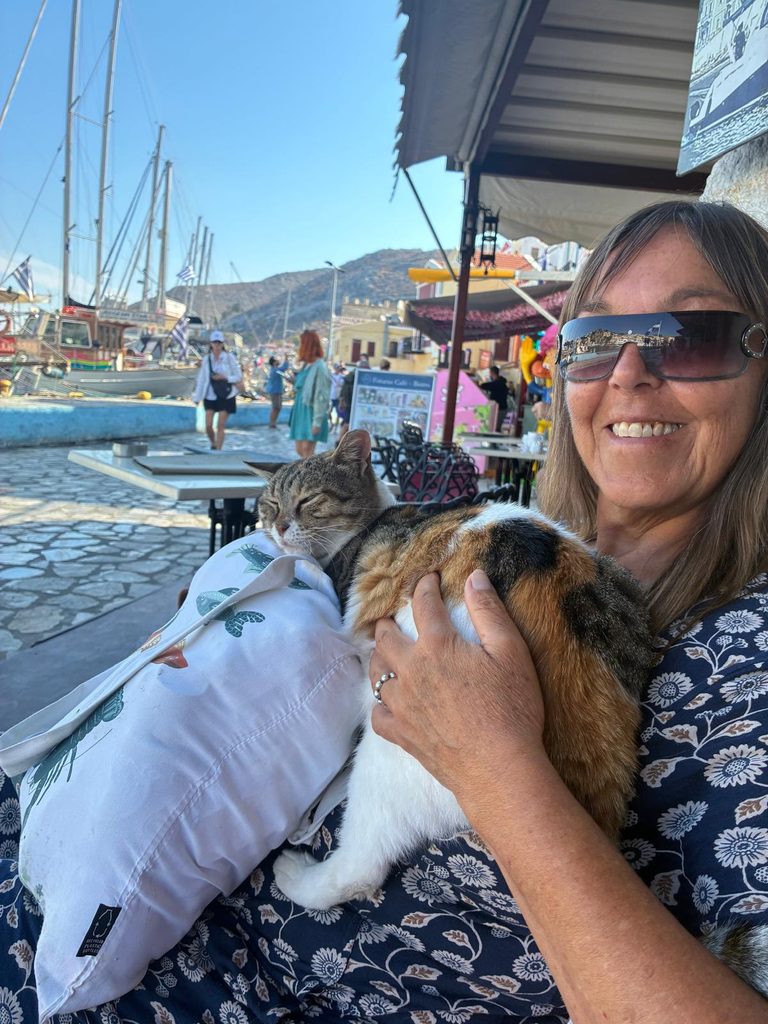
Greece, along with Turkey, is known for its picturesque, well cared-for street cats who pose decoratively on postcards and travel posters. Behind the scenes, the suffering goes unnoticed to most visitors. There are many parts of the world where animal welfare is not part of the general psyche. This can be due to religious conviction, tradition or simply economic: if you’re having a tough time feeding your family, your compassion is less likely to extend to the stray cat hanging around your dustbins. This is slowly changing, of course, with the increase in tourism to some places which have historically had the worst record in this regard. In many cases it’s the tourists themselves who enforce or elicit this change, setting up rescues, feeding programmes and, where possible, TNR (Trap, Neuter, Return).
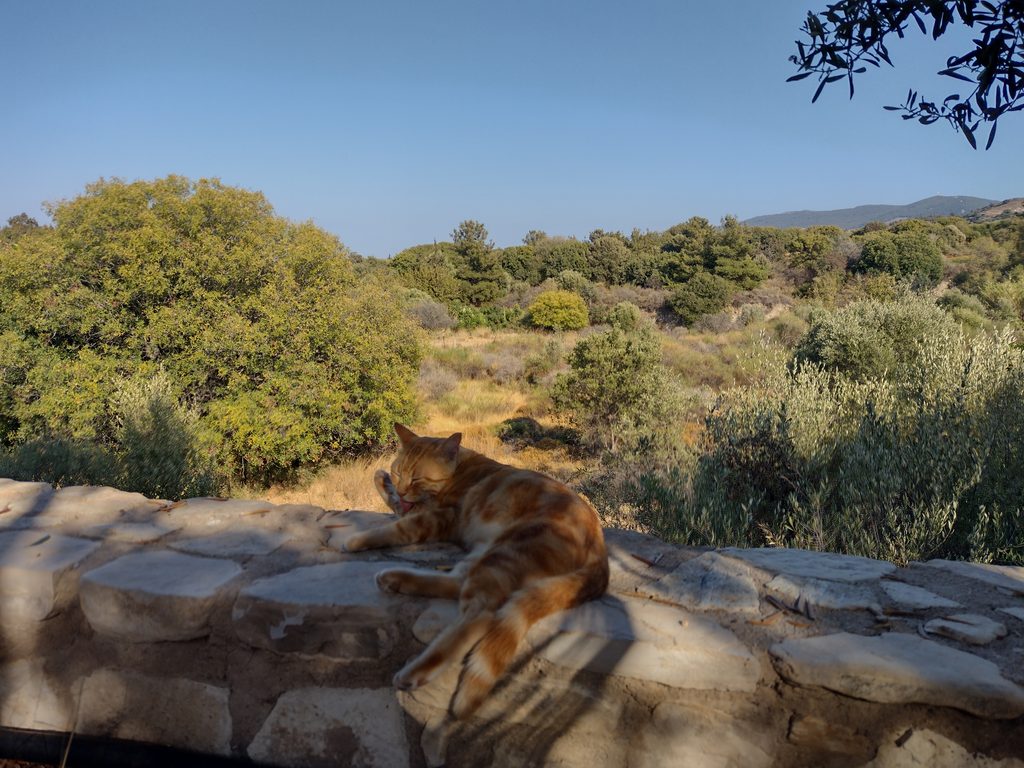
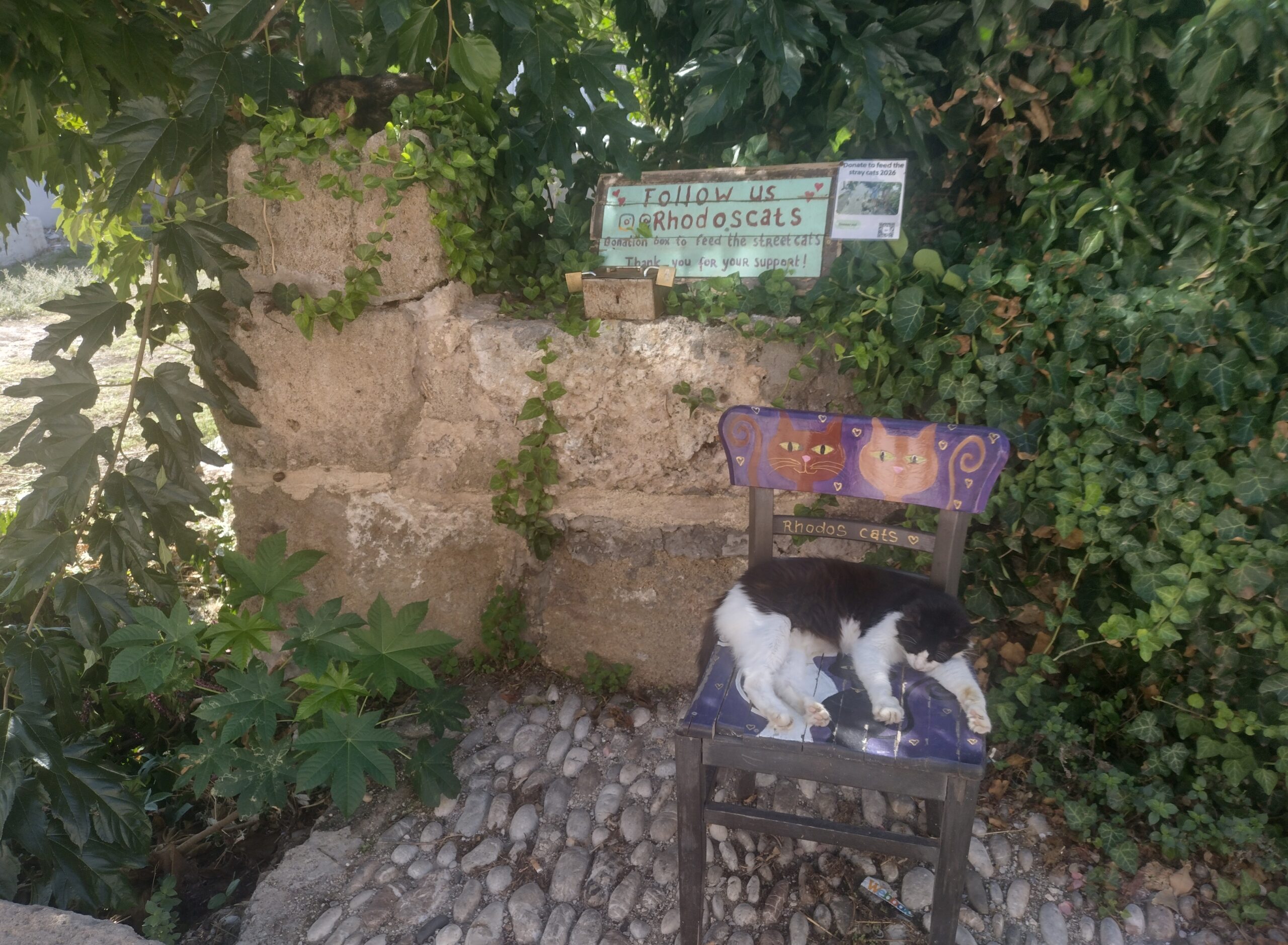
After education, which can take generations, TNR is by far the most important and effective solution towards ending the epidemic of sickly street animals with their cycle of reproduction, misery and death. Of course, when faced with a needy, starving animal, the immediate response is to feed it. The Greek Islands are full of well-meaning locals, and incomers from other parts of Europe, who take on the responsibility of feeding cat colonies who would otherwise starve, particularly over the winter months when restaurants close and tourists are few. While this is admirable, a well-fed cat will reproduce. Its healthy kittens are likely to have litters of their own before they reach adulthood (often dying in the process). An unspayed female cat can, with her descendants, be responsible for hundreds or even thousands of unwanted new lives, though three quarters of them won’t reach maturity. Unseen, unwanted, unnamed. How much more sense does it make to sterilize one cat than to continue feeding the ever-increasing hoards?
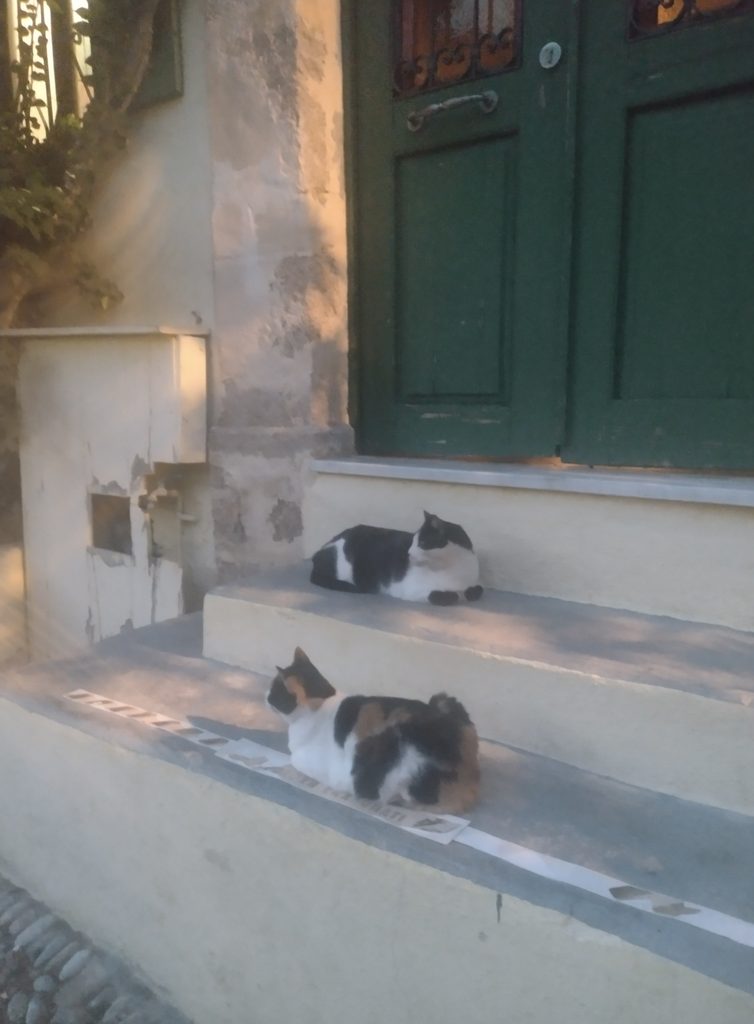
With this in mind, with the commencement of my Vistas ‘Sketchbook Journey’ through the Greek Islands, I have pledged to donate a proportion of each holiday cost to a cat neutering project. While planning the itinerary I visited several islands, each with their own cat populations in varying states of health and management. On the larger islands – Kos, Rhodes – vets, cat rescue centres and TNR programmes are active, although the scale of the problem is still perfectly evident. One place I chose as a place to stay had nine rescue cats last year. This year it had risen to twelve. They’re doing more than their share and it’s wonderful to see, but they have the space and the finances; it’s a drop in the ocean, sadly.
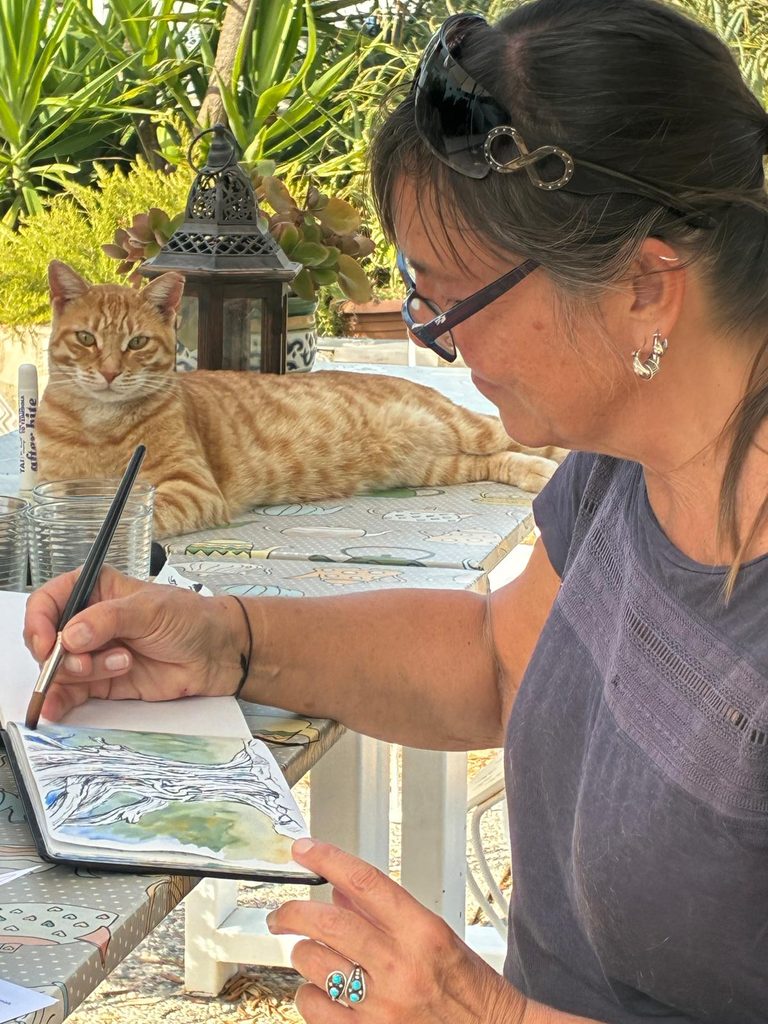
Tiny islands such as Telendos seem to have the situation under better control; there are plenty of cats, but they appear to be cared for, perhaps communally, tolerated and not proliferating. Then we reach Symi, where we spend the longest time on the painting trip, incredibly pretty and photogenic it’s a firm favourite, attracting return visitors year after year.
I chose Symi as the place to focus because, distressingly, their stray numbers seem to be increasing. Efforts to identify an active local TNR group failed repeatedly, until I learned that there isn’t one, anymore. A vet occasionally comes across from Rhodes, and operates on a ‘handful’ of cats. British vets once regularly volunteered until Brexit; now they are not given permission, their qualifications unrecognised.
Under a new Greek law, the Municipality is required to control the stray cat population by neutering, and I have been told they caught and desexed 150 cats this year. There are rumours that several islands ‘clean up’ prior to the start of the tourist season by dealing with the cats in other ways. The Symi locals, apart from a few dedicated cat lovers, seem to range from apathetic to antagonistic. Perhaps when tourists shout loudly enough, in large enough numbers, ears may prick.
In this global epidemic the UK, supposedly a ‘nation of animal lovers’, fares little better. This is no criticism of the wonderful rescues who dedicate their lives to animals and do an incredible job saving, sheltering, nursing and rehoming many thousands of cats and kittens annually. But why is it still such an ongoing problem? We all know what causes pregnancy, right? When I was little, I believed that animal cruelty would surely have disappeared by the time I grew up. Things naturally progressed, didn’t they?
I will continue to do what little I can, when I can, even if that’s sometimes merely ranting about it. While I now realise I will never be able to found a proper rescue or sanctuary, I will have cats of my own again, when it’s feasible to do so. They will, obviously, be adopted; perhaps from Greece. If the endless parade of needy souls tug at your heartstrings and you begin to feel it’s all hopeless, I’ll leave you with one of my favourite quotes:
Rescuing one cat won’t change the world. But it will change the world for that one cat.